Always free
Free tutoring videos
Short videos that teach the basics of each course. You’ll find them on each course page. I’m still uploading more as time goes on, so check back.
Browse the videosI’m Ahmed Imran, a 12th grader at Dubai American Academy. I tutor the AP® courses I’ve already taken (two 5s and three 4s so far), the four I’m taking this year, and math all the way from IM1 to AP Calculus AB.
I started tutoring privately in November 2025, and last school year I tutored 35 students from DAA and nearby schools. This year I turned it into a business, 5fold, and launched this website. I started the year with 55 students. More about me
Your first consultation and one-hour session are free, online. My tutoring videos and answers to your questions are always free. See what’s free
I want to help as many students as I can, not only the ones who book sessions. These two things are free for everyone, whether or not you ever pay for tutoring.
Always free
Short videos that teach the basics of each course. You’ll find them on each course page. I’m still uploading more as time goes on, so check back.
Browse the videosAlways free
Stuck on a topic, a homework problem or how a course works? Email me and I’ll answer for free. You don’t need to book a session or pay anything.
Email a free questionTap a course to see my background in it and what we’d work on in sessions.
Tap a course to see my background in it and what we’d work on in sessions. Course pages also have free tutoring videos on the basics, and I keep adding more.
AP Research is a whole year on one question you choose yourself. It ends with an academic paper and a presentation you have to defend live. I got an A+ both semesters and a 5.
How do AI writing tools affect high school students’ cognitive abilities?
You can’t use my paper. It’s already been submitted, so any part of it in your work will get flagged for plagiarism.
Right now: I’m mentoring 3 AP Research students through their papers.
Paper reviews. I comment; you write. AP Seminar and AP Research work has to be your own, so I never write or rewrite any part of a paper. If your official performance task has already started, check your teacher’s rules on outside feedback before you send it to me.
Free videos on the basics of the course. I upload more as time goes on, and sessions go into much more depth.
My AP Research academic paper, which scored a 5 from College Board. It’s here as an example of what a top-scoring paper looks like.
You can’t use my paper. It has already been submitted to College Board, so copying, paraphrasing or reusing any part of it in your own work will get flagged for plagiarism. Read it for ideas on structure and method only.
Word count: 5,386. Download the original (.docx)
As the world advances, it is no surprise that Artificial Intelligence has quickly become a part of almost every aspect of our lives. This is especially true among students learning in classrooms, specifically students in high school. The rapid integration of AI writing tools like ChatGPT into these classrooms has completely transformed the way students write, learn, think, and solve problems. As these tools become embedded in daily academic course work, educators and researchers have become growingly concerned about the cognitive effects, like critical thinking, creativity, and metacognition, of overreliance on these tools. Cognitive science theories like the Cognitive Load Theory (Sweller, 1988) and Distributed Cognition (Hutchins, 1995) suggest that when individuals heavily rely on external writing tools, especially those which use AI, to complete tasks that require critical thinking, cognitive effort can decrease, which can negatively affect long-term cognitive development. This raises the question: are these tools supporting the thinking of students, or is it gradually replacing it? Understanding the cognitive impact that these writing tools have on adolescents is absolutely vital as although its popularity among high school students, there is limited research on its effect on high school students specifically, whose thinking skills are under significant development, with research focusing more on university students, who are full grown adults. This represents a clear gap because how can we know its true effect on individuals, specifically students, when we do not know its true effect on adolescents.
A major concern in current research is that AI writing tools may reduce the cognitive effort students invest in complex thinking tasks. Vieriu and Petrea (2025) cited that even though these tools allow students to write faster with fewer errors, they usually also lead to significantly weaker engagement with reasoning and idea development. Tran (2023) also notes that students who rely heavily on these AI writing tools usually skip the analytical steps when it comes to writing. This can go on to limit students’ ability to form independent arguments. This presents a clear trend: efficiency up, cognitive depth down. However, some researchers have also begun to think about if AI’s harm on critical thinking depends on how you use it. Kasneci et al. (2023) argue that AI can actually support critical thinking when used for brainstorming, generating arguments, or providing new perspectives. Although this, analysis shows that when students use AI writing tools to generate texts instead of doing their work themselves, critical thinking skills take a dip as students begin to rely on the model’s reasoning instead of their own (Deng et al. 's, 2024). This means that when AI becomes part of a student’s thinking system, reasoning becomes weakened.
A recurring finding across studies is that AI negatively affects students’ creative thinking. Specifically, it is noted that originality and idea generation is negatively impacted. For example, Farhan found that when students used AI to generate ideas or draft content, their work contained less original expressions as it was very focused on standardized wording (Farhan, 2025). This suggests that AI can homogenize the creativity of students. More studies further support this, stating that students who used AI had essays with stronger structure and vocabulary but significantly less creativity, specifically in terms of novelty and risk-taking (Bauer and Li, 2023). This all leads to the point that AI further harms creativity in students. At the same time, there are some ways in which AI writing tools support creativity. For example, one study cited that these tools can allow students to increase the fluency of their ideas, especially during the brain storming stage (Deng et al, 2024). Similarly, another study cited that it can act as a creative catalyst if students use it to explore different perspectives and possibilities rather than use it as a substitution for original thinking (Kasneci et al, 2023). This gives a new perspective, where AI actually promotes creativity.
Another major issue arises around increasing dependency on AI which can weaken learning autonomy. Studies found that frequent use of AI writing tools has been heavily linked to less self-regulation and weaker persistence when it came to writing and reasoning tasks (Zhang and Wang, 2024). Students who relied on AI heavily, were much less able to initiate cognitive effort than other students. It was also observed that when students frequently looked to AI for support, they were less engaged in their courses, and ended up learning less. This shows that frequent use like this can actually corrupt students’ ability to learn. However, it is important to note that dependency can be avoided, it just requires a healthy relationship with AI. It is noted that when teachers guide AI use through reflective activities or discussions, students convey greater autonomy and awareness. Bai and Guo (2024) also found that AI supported autonomous growth only when combined with teacher feedback. This means that without guidance, students can become dependent on AI.
Research shows that the use of AI writing tools can actually impact students’ motivation and metacognition awareness. Patel and Singh (2024) found that students who consistently used AI often overestimated their knowledge of certain topics, meaning they assumed that they knew more than they did. This level of overconfidence is suggested to be related to diminished metacognitive monitoring since students rely on AI correctness rather than their own reasoning. Motivation is also affected. For example, one study found that while AI tools increased productivity and reduced the frustration associated with complex tasks, they also decreased students’ persistence and motivation when faced with problems (Miller and Becker, 2023). Another study supports this by showing that when students depend on these AI tools, they usually exert less mental force overall and may avoid tasks requiring thought or reasoning. However, several studies emphasize that these negative effects can be controlled through intentional instructional practices. Okafor and Yamada (2025) demonstrated that metacognitive prompts like asking students why or how they used AI improved their critical thinking significantly. Similarly, another study showed that combining AI use with teacher feedback seriously pushed students to reflect on their writing choices; this strengthened their motivation significantly.
It is vital to teach students about AI literacy. This looks at its limitations, how it works, and how to use it responsibly. One study found that students who had higher AI literacy than others had better thinking skills and were more capable of questioning AI generated answers (Kong and Li, 2024). Students with lower scores were way more likely to take AI suggestions seriously and uncritically, with a mindset that AI is always right; this leads to poorer reasoning skills within these students. This suggests that AI usage is heavily linked to students’ ability to evaluate information clearly and maintain cognitive engagement. AI literacy can also protect against overreliance. A study by authors Chen and Arora (2024) found that students who had a lack of knowledge on how AI systems operate tended to use them more frequently than others, showing why understanding how it works is vital. Despite its importance, AI literacy instruction is not yet widespread in secondary schools. As a result, students develop independent habits; sometimes these can be productive, but they often are dependent or unreflective.
Throughout the existing research, there are several key gaps. One of these gaps is the fact that there is very little information available when it comes to the cognitive effects of AI writing tools on high school students. Most studies focus on university students when they mention the word ‘students.’ This leaves a clear population gap that needs to be explored for the sake of adolescents around the world that are becoming more integrated with AI everyday. These adolescents have vital skills like creativity and critical thinking that are still developing. Although a few studies examine secondary education, they remain limited in number and depth. Secondly, there is a clear methodological gap. Much of the research relies on surveys, perceptions, or self-reported behaviors rather than cognitive task results based on performance that directly measure reasoning or creativity. Third, a theoretical gap exists. While some articles reference theories such as Cognitive Load Theory or Distributed Cognition, many do not use established cognitive frameworks to explain why AI may influence thinking. Lastly, there is a measurement gap as there is no standardized way to test creativity or critical thinking, making the comparisons across different sources very difficult.
This extensive research project utilised a quantitative cross-sectional correlational design that examined the statistical association between consistent AI use and cognitive performance, which includes metacognitive awareness. This study directly allows me to test my hypothesis if higher self-reported AI usage is associated with lower scores on the cognitive skills and metacognitive awareness scales. The quantitative cross-sectional correlational design allows me to:
Measure statistical differences
Compare AI use levels with cognitive scores (find connections between results)
Identify patterns across a good population
Find numerical evidence that can back up my hypothesis
Cognitive Skills/Reflection - The ability to override intuitive responses and engage in analytic reasoning.
Metacognitive Awareness - The awareness and regulation of one’s own thinking processes.
Self-reported AI usage frequency (1–10 scale)
Cognitive reflection score
Metacognitive awareness score
Participants were high school students in grades 9-12, and were asked to fill out a google form, where their identities remained anonymous to protect user privacy. A non-random, voluntary response sampling strategy was employed. The survey was distributed to the high school body through Whatsapp, on each grade level’s respective group chat, which includes the majority of each grade’s students. To get the survey onto the group chat, I text-messaged the student body president, who forwarded the message onto the group chat. Due to time constraints and access limitations within a single high school population, a sample size of 40 participants was considered feasible while still allowing for meaningful statistical analysis. To ensure that this sample size was final, the form was closed after 40 responses were collected.
14 total questions.
7 questions on cognitive skills/reflection (scored out of 7).
7 questions on metacognitive awareness (scored out of 35).
The first part of the quiz measured cognitive reflection using problem-solving questions where the volunteers selected the correct answer, while the second part assessed metacognitive awareness through Likert-scale statements evaluating students’ awareness
On the quiz, participants were asked to first indicate how often they use generative AI like ChatGPT or Google Gemini on a scale of 1-10. In the survey instructions, participants were explicitly informed that this rating referred to using generative AI to complete assignments, generate answers, or solve academic problems independently, rather than using it solely as a learning or clarification tool. This distinction was vital to ensure that the variable measured cognitive outsourcing rather than supportive study behaviors.This score was treated as a continuous variable in analysis. Then, they were asked if they consent to their answers being used in a research study that will find the correlation between AI use and cognitive/metacognitive results. If the student chose “NO,” their responses were manually deleted and not taken into consideration for the research results.
For the first question, if students chose 10, it meant that they use generative AI frequently while if they chose 1, it meant that they rarely used it. In terms of the scoring, the first part of the quiz (cognitive skills/reflection) was graded through 7 marks on 7 questions where for each question, the student would receive 1 mark per question for getting the answer correct. This means that the score range would be 0-7/7 with a higher score indicating strong analytical reasoning. The second part of the quiz (metacognitive awareness) was scored out of 35 total points. They were asked another 7 questions, marked out of 35 marks. In this part of the survey, there was no exact right or wrong answer as it recorded how aware and regulated the student really is. They were not given questions here but statements, where they indicated how much they agreed with them.
For Example: One question stated “I know when I understand something and when I do not.”
Participants were then given the opportunity to choose from 5 choices:
Strongly Disagree - 1 Point
Disagree - 2 Points
Neutral - 3 Points
Agree - 4 Points
Strongly Agree - 5 Points
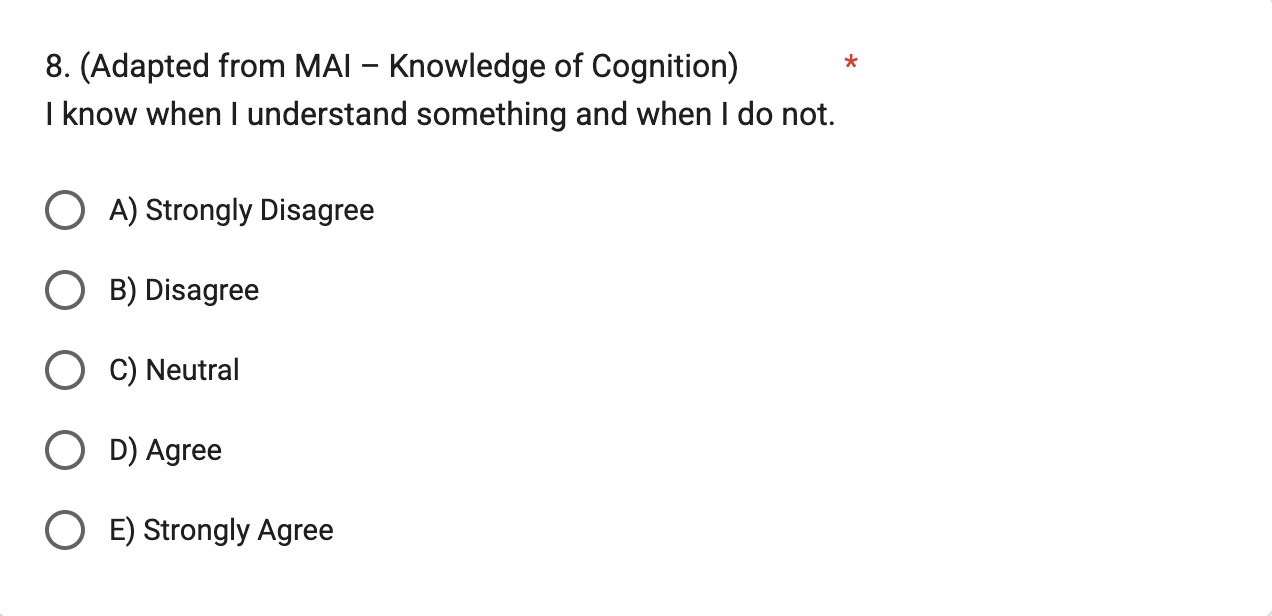
Since all 7 statements are positive and good traits, agreeing with them leads to a high score, which indicates greater metacognitive awareness.
After the google form was sent out, it was open for responses for exactly 14 days, allowing the predicted sample size to be achieved. The data was collected on google forms and responses were checked and confirmed after the form was closed. Since the form could only be responded to once per person, duplicate responses were non-existent. As all 14 questions were mandatory to fill the form, there were no incomplete responses to be removed and all responses were taken into consideration for the research, aside from those students who chose “NO” on the consent form and their responses were deleted.
After the survey closed at 40 responses, the responses were compiled in Google Forms. They were exported to Google Sheets for data analysis. In Google Sheets, each response was separated as a single row with the format as follows:
Column A: AI usage frequency (1–10)
Columns B–H: Cognitive reflection quiz(Q1–Q7)
Columns I–O: Metacognitive awareness items (Q8–Q14)
Each of the 7 cognitive reflection questions had 1 correct answer out of 4 with correct responses coded as “1” to represent a point and incorrect responses coded as “0” to represent no points. A total score was added up for the cognitive reflection skills and added to a new column for part 1 of the survey.
A similar method was applied to determining the metacognitive awareness score where the maximum number of points per question was 5 and the minimum was 1. Because Google Forms does not automatically assign different point values to Likert responses unless using quiz mode (which was not used for this section), responses were manually converted by myself and typed into google sheets manually. When the information was transferred from Google Forms to Google Sheets, the data for the metacognitive awareness part of the survey was actually deleted so that it could be entered myself to maintain organization and accuracy for the score as it was unscored on the Google Form. These values were added onto a new column corresponding to each metacognitive statement. Since all of the statements were positively worded, reverse scoring was not required for any of the metacognitive awareness items.
The next part of the data analysis was split into 2 parts:
Independent Score Analysis
Graphical Representation
Independent analyses were chosen for this study since cognitive reflection measures analytic reasoning while metacognitive awareness measures self-regulation. These two are distinct constructs and should not be combined for one score since they can be unrelated to one another. For the independent score analysis, a total Cognitive Reflection score (0–7) was calculated for each participant by summing correct responses and a total Metacognitive Awareness score (7–35) was calculated by summing Likert-scale values. These dependent variables were analyzed separately. Here, Pearson correlational testing was used between the results on each part and their indication of how often they use AI (1-10).
Next, graphical representation of the data was done to display statistical results. This visualization helped assess direction, spread, and potential linearity. This was done in addition to statistics to better visualize the results and pinpoint correlations. These graphs also help directly recognize potential outliers, which may not correlate with the majority’s results based on their scores.
Graphical Representation:
Scatter Plots
Bar Graphs
A total of 4 graphs were created with 2 scatter plots and 2 bar graphs for cognitive reflection and metacognitive awareness (1 bar graph and 1 scatter plot for each). For each cognitive reflection vs AI usage graph the X-axis indicated the AI usage while the Y-axis indicated cognitive reflection. For each metacognitive awareness vs AI usage graph the X-axis indicated the AI usage while the Y-axis indicated metacognitive awareness.
Following this, the results were examined to determine the association between AI use and metacognitive awareness/cognitive reflection.
After a total of 40 participants completed the survey, all results from both parts of the test (both variables) were taken for analysis.
Following the first question of the survey, which measured AI usage on a scale of 1-10, the mean was calculated as 5.50 with the standard deviation at 2.84. Responses spanned the full range of 1-10.
Following the 7 cognitive reflection questions, the mean result was 3.73 with the standard deviation at 1.8 from a range of 1-7. Responses spanned across this full range.
Following the 7 metacognitive awareness questions, the mean result was 24.68 with the standard deviation at 5.46 from a range of 15-35. Responses spanned across this full range.
The value of “r” ranged from -1 to 1. It measures the strength and direction of the possible relationship between 2 variables. If the number is a negative value, it means that if one variable increases the other variable tends to decrease. For example, if the value is r = -0.67, it could be interpreted that as AI usage increases, cognitive reflection scores decrease. A number closer to -1 indicates a stronger relationship between both variables.
Following Pearson correlational testing, the cognitive reflection test indicated the value of r = -0.71. This shows a strong negative correlation between AI use and cognitive reflection. It indicates that as AI use increases, cognitive reflection scores decrease. This suggests a clear consistent pattern across the results.
The metacognitive awareness test indicated a value of r = -0.61. Similarly, this suggests a moderate negative correlation between AI use and metacognitive awareness. The results indicate that as AI use increases, metacognitive awareness decreases. This relationship is noticeable and relatively consistent across all results.
Both results show negative correlation.
Cognitive reflection results indicate strong negative correlation.
Metacognitive awareness results indicate moderately negative correlation.
This indicates varied results across both areas.
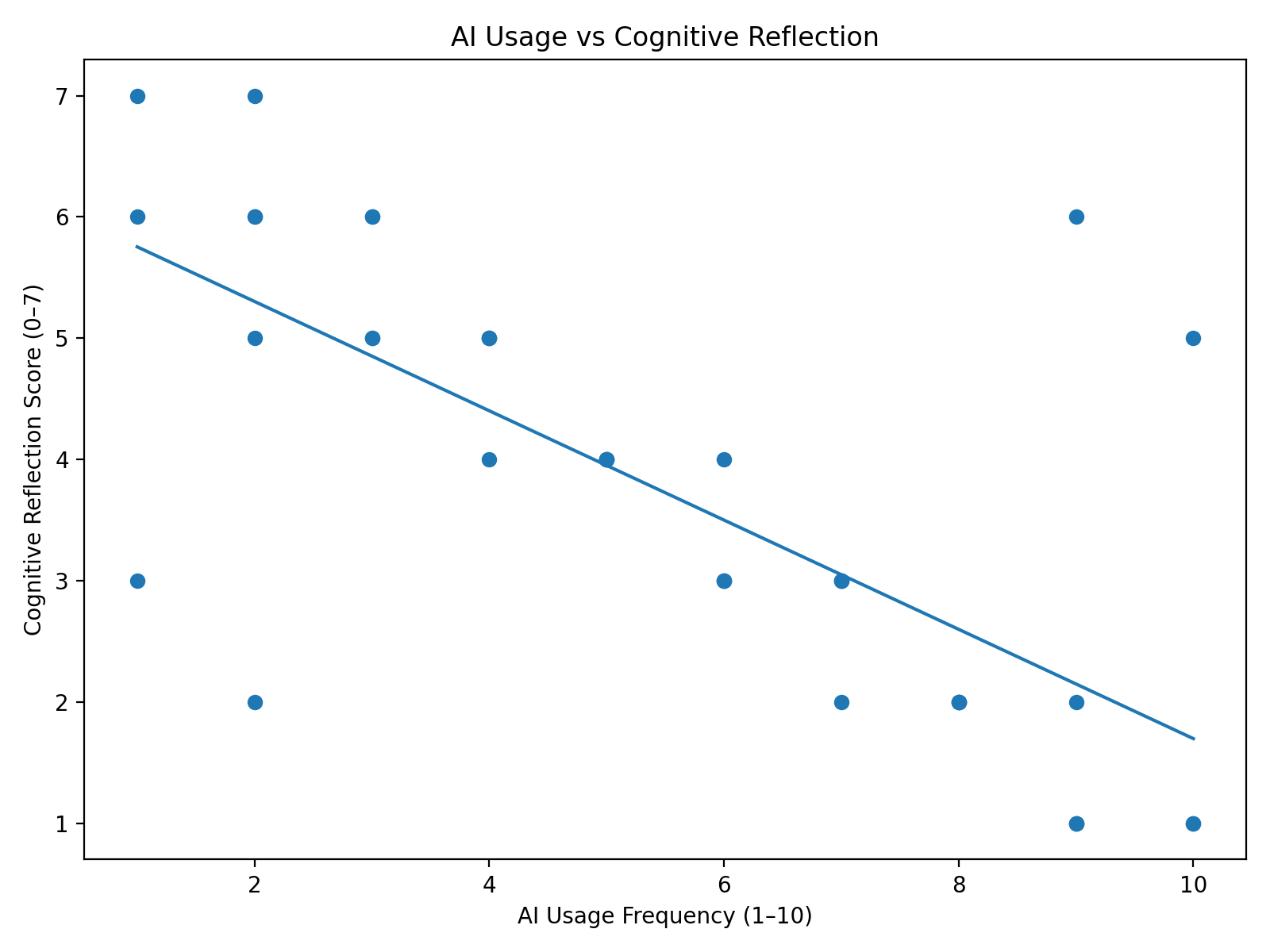
The graph shows a clear and strong downward trend across the scattered points. As expected, there are some outliers which do not match the majority’s results. These outliers are those furthest away from the line of best fit. This visual clearly supports the negative correlational value through showing the negative slope.
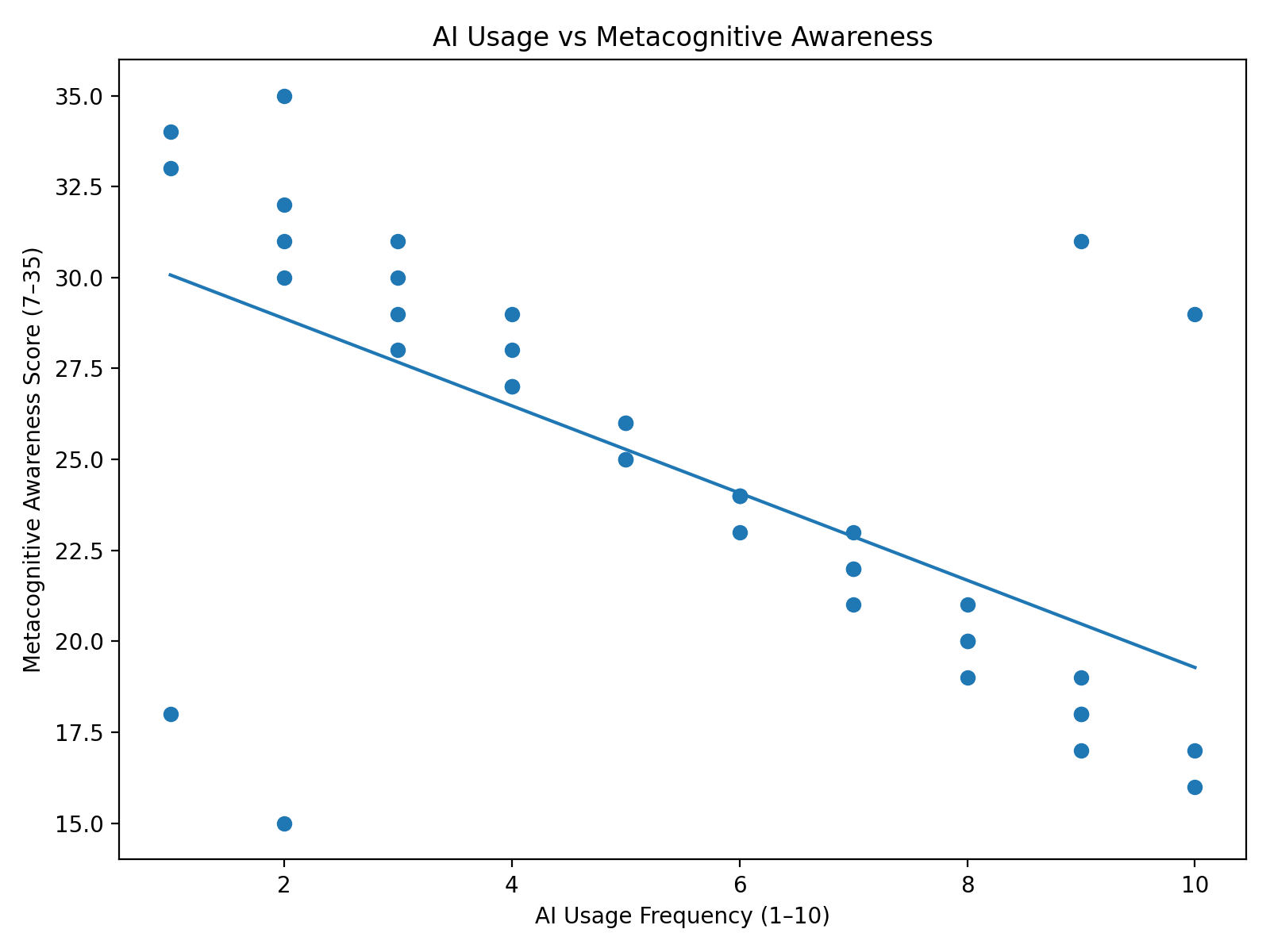
The graph shows a clear and moderate downward trend across the scattered points. As expected, there are some outliers. These outliers are those who are furthest away from the line of best fit and do not match the majority’s results. This visual clearly supports the negative correlational value; however, the negative slope is not as strong as in Figure 2 with points less clustered.
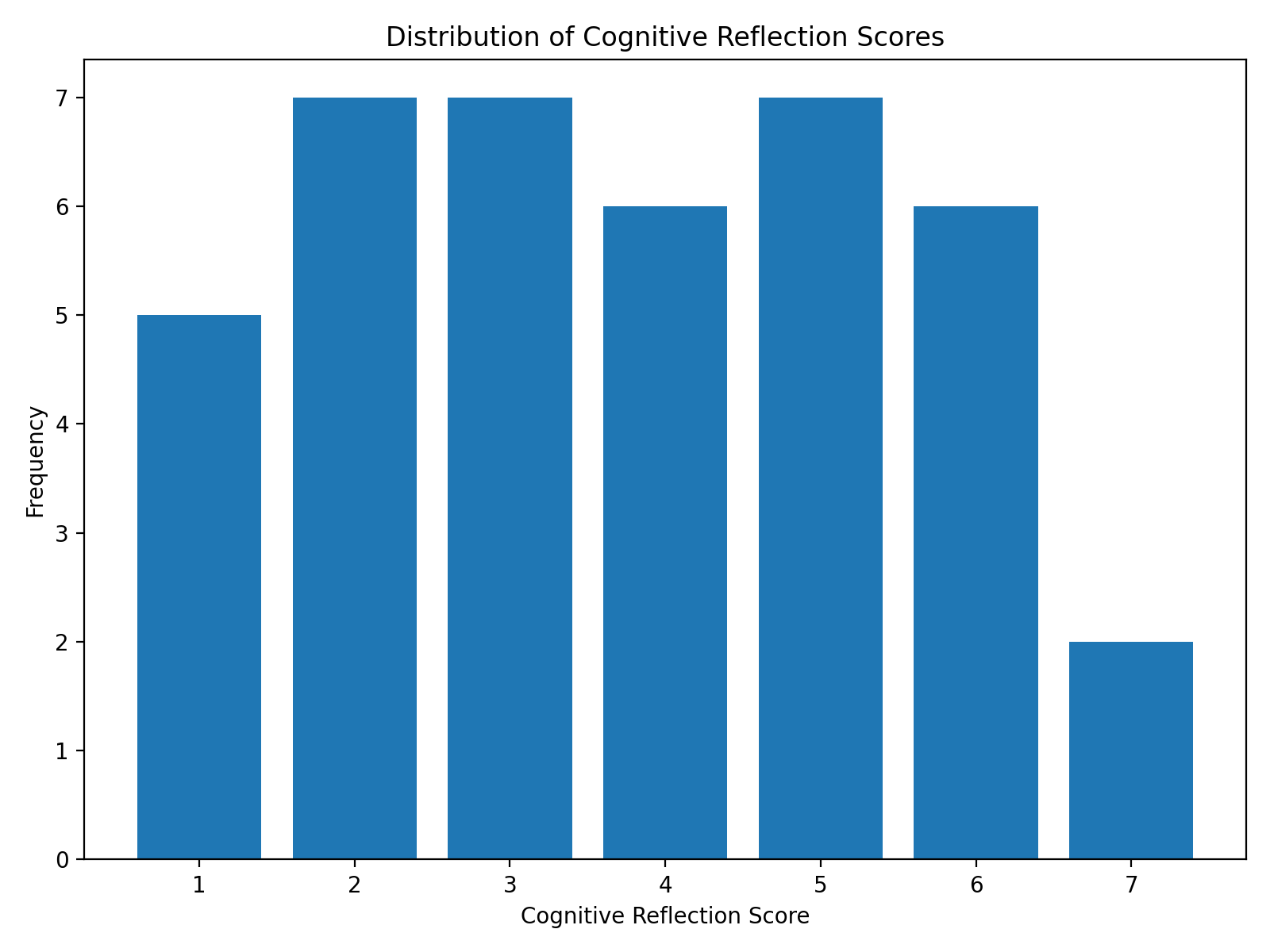
This graph shows the distribution of cognitive reflection results across the range of 1-7. Most scores are between 2-6 with some outliers. The graph aligns with the mean of 3.73.
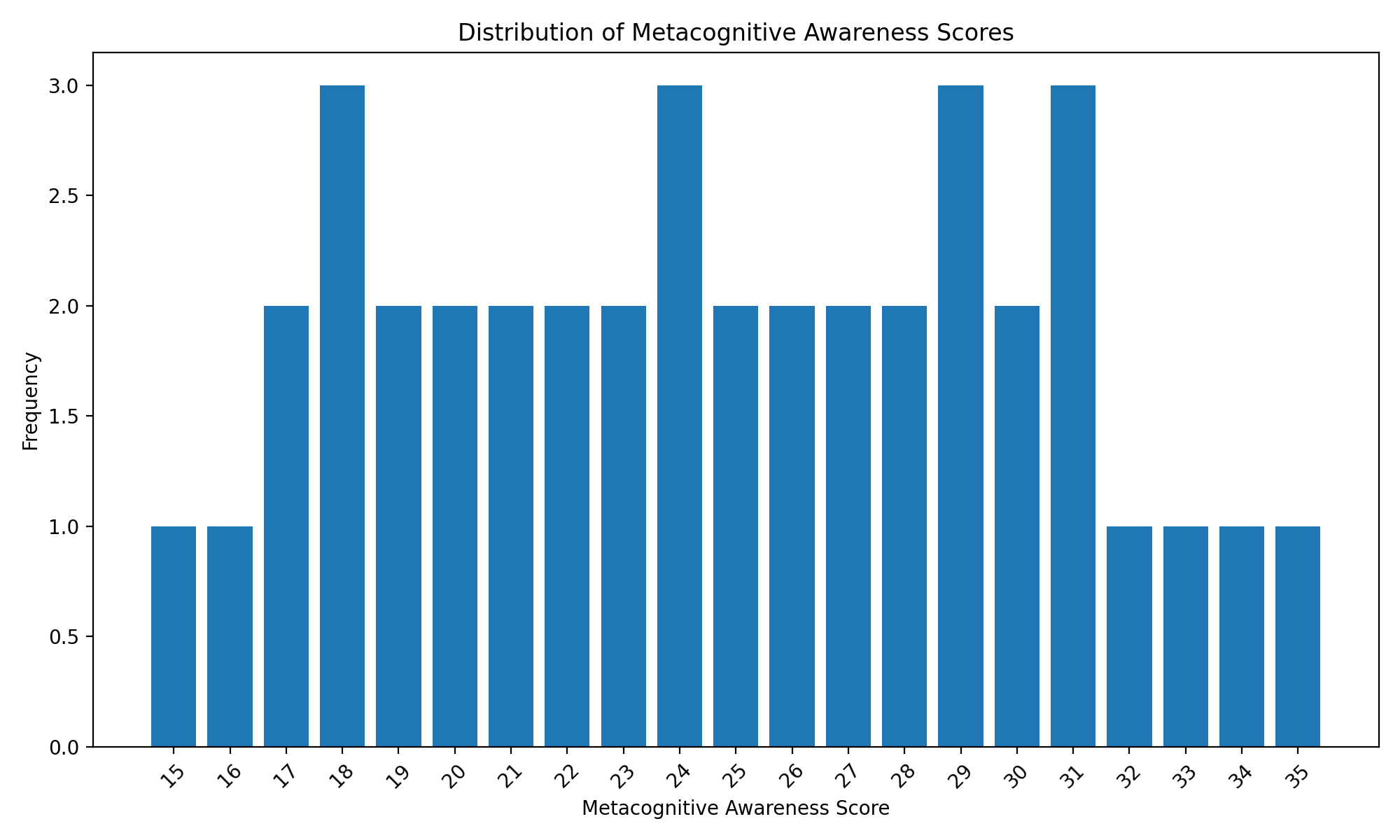
This graph shows the distribution of metacognitive awareness scores across the range of 15-35, with most participants achieving 18, 24, 29, and 31. The graph aligns with the mean of 24.68.
Overall, these results demonstrate varied results with both areas demonstrating strong negative correlations with AI usage.
The purpose of this study was to examine the relationship between AI use and both cognitive reflection and metacognitive awareness. The study focuses more on cognitive impact rather than AI usage itself and the analysis aims to understand how and why AI use affects these domains.
The data shows that as AI usage increases, both cognitive reflection scores and metacognitive awareness scores decrease. This is more apparent in cognitive reflection scores which have a stronger negative correlation than the metacognitive awareness scores. This means that an increase in AI use may be associated with reduced performance. This was a consistent pattern across most participants in both categories.
In regards to cognitive reflection, the strong negative correlational value suggests that students who use AI frequently, may rely on analytical thinking less than those who do not. This is apparent in the data, where the majority of students who indicated that they use AI frequently, scored significantly lower than students who indicated that they do not. Cognitive reflection requires effort and problem solving skills so, when AI provides students with quick, simple, and effortless answers, students can easily skip the critical thinking process in their work and may end up engaging less in the type of reasoning that strengthens their cognitive reflection skills. This may directly influence the lower average scores that frequent AI users have achieved on this quiz. However, it is important to note that there were some outliers in this part of the test. This means that not all students follow this pattern with some achieving high cognitive reflection scores with an indication of high AI use and some achieving low cognitive reflection scores with an indication of low AI use.
In regards to metacognitive awareness, the moderately negative correlational value suggests that students who use AI frequently tend to score lower on the metacognitive awareness test than students who use it less. The data shows that most students who indicated that they use AI frequently are less likely to reflect on their work and monitor their work actively compared to students who use AI less frequently. This means that frequent use of AI may impact a student’s awareness of thinking and monitoring of their understanding. Since students were asked to indicate their feelings on statements like “I know when I am confused,” their responses directly reflect their self-reported awareness on recognizing confusion and understanding levels. This means that the data supports the theory that frequent AI use may push students to not check their understanding.
Although this, the data indicates that the relationship between metacognitive awareness and AI usage is lower than the relationship between cognitive reflection and AI use. This is because metacognition indicates awareness rather than actual performance so, some students may recognize when they feel confused or stuck even if they use AI frequently. This explains the weaker correlation and higher variation in this part of the study.
According to the results of the study, frequent AI use has a stronger impact on cognitive reflection than it does on metacognitive awareness. This means that even though there is evidence that AI can significantly replace a student’s thinking, it can only moderately impact a student’s awareness of thinking.
It is important to note that the findings of this study are aligned with the findings of other researchers. Other studies also confirm that although AI improves efficiency, it can dangerously alter critical thinking skills in developing minds. For example, several studies support the theory that when students use AI to complete tasks, they miss out on improving critical thinking, cognitive effort, and reasoning skills (Vieriu & Petrea, 2025; Kasneci et al., 2023; Deng, Lin, & Zhang, 2024). The correlation found in my study aligns with this as frequent AI users ended up with lower cognitive reflection scores. This is because a high cognitive reflection score requires effortful thinking and strong analytical thinking. Additionally, a strong cognitive reflection score requires frequent practice, which, according to studies by these researchers, decreases with frequent AI use as AI replaces the need to think and gives quick and easy answers to complex questions that take time to be answered. This means that the depreciation in practice with AI use may lead to weaker performance.
Furthermore, several sources also align with my hypothesis that metacognitive awareness can be negatively affected by frequent AI use. These sources found that frequent AI use can reduce self-monitoring and learning autonomy. This means that students can end up completely relying on AI rather than checking their work and actual understanding of the topic. This was apparent in my data, where students reported less monitoring with high AI usage; however, the effect in my study was moderate with multiple outliers, meaning it may only decently affect some students. Moreover, other researchers cite that true AI impact depends on how it is actually utilized with guided use mitigating the negative effects. This means that not all students are affected equally. This explains the outliers, who did not align with the majority, and the weaker correlation in this part of the study. This means that metacognitive awareness had a partial impact with awareness affected less than reasoning.
Overall, these findings show that AI can potentially have negative effects on how students learn and function. Prior research has emphasized its effects on older students in university however, it is important to understand its effects on students in high school, a period in their life when the brain is developing rapidly. Also, these prior studies often used self-reported data and did not directly quiz students on their abilities. This meant that we could not find a direct correlation between these domains. This is vital to know as habits formed at this young age can develop into long-term cognitive issues. However, it’s important to understand that this is not the case for all high school students. Throughout this study, there were many outliers. These outliers are a prime example of how AI itself isn’t really bad, it’s the way it's used. If handled properly, students can achieve high scores in these fields while using AI frequently. This is where we need to directly address how they should be learning to use AI.
Throughout this study, I faced several limitations that weakened the reliability of my study. Firstly, I was limited to a sample size of 40 students. This comprehensive study was conducted based on the responses of 40 participants. This small sample size means that one or two outliers can alter the overall pattern more than they would in a more sizeable study. This means that a larger sample size would ensure more accurate results, when trying to display an overall pattern. Additionally, this sample size makes it difficult to determine whether this pattern would be visible across a larger student body. Although the study is useful, it is crucial to understand that the evidence only represents a limited group of students and does not represent the results we could see in high school students regionally or even globally.
In addition to this, the student body selected to participate in this study came from a single high school. This is important to know because every school handles teaching, technology, and integrity differently and these results could just reflect the results of that school specifically. This is since a student body from one school may have similar levels of knowledge or principles when it comes to handling technology or being tested for cognitive abilities. So, a school with a different academic system or rules may perform differently in this test. This means that this test is best for testing the environment in a single school.
This study relied on students to indicate their AI usage on a scale of 1-10. This reliance may cause issues as students can indicate false levels of frequency. This is since some students may not want to admit how much they actually use AI. Since there is no way to truly verify the students’ answers, we rely on students’ perception and not their exact true behavior. Although this information is still valuable, the failure to verify the students’ answers can create slight unreliability in the test results.
Moving forward, another clear limitation was the outliers. Some participants did not follow the overall trend. This shows that the results are not perfect and do not apply to everyone. It means that there can be other things directly influencing cognitive performance rather than just AI use itself. This means that the findings of this study represent a general trend and should not be reflected as a representation of every student.
Since the study aimed to examine the relationship between cognitive performance and frequent AI use, a correlational study was the best option. A correlational study can directly show consistent patterns between both variables. This allowed the study to see if cognitive performance decreases with frequent AI use.
The survey was distributed through Google Forms as Google Forms is a reliable and efficient platform for simple surveys or tests. It allowed the survey to be easily distributed to a large number of students within the small time frame. Google Forms also supported anonymous responses as it has an option to not record students’ email addresses which may have increased honesty and reliability. This protection of privacy allowed students to answer questions without feeling embarrassed or frustrated with their possible results. Google Forms also allows data collection to be efficient and really easy to organize as it has features that allows the data to be exported and organized into Google Sheets. Google Sheets was the best platform for storing this data. It has high levels of security and easily converts statistical data into graphs.
The test measured both cognitive reflection and metacognitive awareness as these variables allow the measurements of true cognitive performance (cognitive reflection quiz) and students’ self-awareness of their thinking (metacognitive awareness test). This allowed the study to explore two domains of cognitive performance to increase the usefulness of the test.
These findings cannot go ignored, and need to be addressed directly. Firstly, students need to be aware of these results. They need to recognize the potential risks of heavy AI reliance. This is important because if students use AI to skip the thinking part of their education, they can end up lacking the skills that education aims to develop.
Along with this, schools must take measures to ensure that this does not become the case with a school’s majority. AI has already been integrated as a part of the learning experience so, schools should not ignore it but should actually embrace using it safely and responsibly. They need to integrate new policies for responsible use and teach students the difference between harmful and helpful use of AI. This should be directly taught by teachers. Teachers need to guide students on using AI as simply banning it can fail in solving the problem. This means that guided use of AI could actually allow students to benefit from it.
Additionally, AI corporations should take active measures to ensure that their platform is used responsibly and does not negatively impact student capabilities. They should work with schools and teachers to implement restrictions for these students so that they benefit from these platforms.
In the near future, schools or even students should conduct more correlational research within these domains. They should use larger sample sizes and should work together across multiple schools to determine the true effects. The larger sample size would ensure that the study is more reliable and more stable, allowing researchers to draw a central conclusion to the topic question.
Additionally, the studies should be conducted over time to see if patterns change as these new policies come into place. This would evaluate their true effectiveness and necessity as evidence can make the usefulness clear.
Along with this, future studies should use controlled experiments. Since this study was correlational, it cannot fully prove causation since this method does not allow us to explore the possible effect of external factors that can alter the results. In a controlled experiment, they could take two groups, instructing one to minimally use AI and instructing another to use it frequently. They could then analyze the results and look for any patterns.
To conclude, the studies show that frequent AI use is strongly associated with low cognitive reflection scores and is moderately associated with low metacognitive awareness scores. This means that frequent AI use in high school students could cause low cognitive performance levels and harm how they approach schoolwork. The focus on high school students throughout this study, ensured that the results would be reliable and applicable for schools to consider when planning to implement new policies regarding the use of AI. This is important since the evidence suggests that we need to take active measures in balancing AI use to mitigate its effects on cognitive performance. In the end, one thing is clear, AI writing tools need to benefit students and support thinking, not replace thinking itself.
Bai, H., & Guo, Y. (2024). How AI writing assistants reshape student learning behavior: A mixed-methods study. Journal of Educational Computing Research, 62(1), 115–132. https://journals.sagepub.com/doi/full/10.1177/07356331231223456.
Bauer, N., & Li, J. (2023). AI and creativity in student writing: Measuring originality in the age of automation. Computers & Education: Artificial Intelligence, 5, 100157. https://doi.org/10.1016/j.caeai.2023.100157
Chen, L., & Arora, P. (2024). AI literacy and its cognitive implications for secondary school students. Technology, Pedagogy and Education, 33(1), 77–92. https://www.tandfonline.com/doi/full/10.1080/1475939X.2024.2456712
Deng, L., Lin, Y., & Zhang, Y. (2024). Exploring the influence of ChatGPT on student learning outcomes: A systematic review and meta-analysis. Computers & Education, 208, 105251. https://doi.org/10.1016/j.compedu.2024.105251
Farhan, H. N. (2025). The impact of AI-powered writing tools on students’ writing performance: A content analysis and future prospects. International Journal of Humanities Social Science and Management, 4(3), 54–59. https://ijhssm.org/issue_dcp/The%20Impact%20of%20AI%20Writing%20Tools%20on%20the%20Content%20and%20Organization%20of%20Students’%20Writing.pdf
Kasneci, E., Sessler, K., Küchemann, S., Bannert, M., Dementieva, D., Fischer, F., Gasser, U., Groß, S., Gunhold, A., & Ifenthaler, D. (2023). ChatGPT for good? On opportunities and challenges of large language models for education. Learning and Individual Differences, 103, 102274. https://doi.org/10.1016/j.lindif.2023.102274
Kong, S. C., & Li, K. M. (2024). Artificial intelligence literacy and its influence on students’ higher-order thinking skills in secondary education. British Journal of Educational Technology, 55(2), 389–405. https://bera-journals.onlinelibrary.wiley.com/doi/10.1111/bjet.13320.
Miller, A., & Becker, T. (2023). Motivation versus automation: The psychological effects of AI use on student persistence and reasoning. Educational Psychology Today, 15(3), 201–218. https://edpsychologytoday.org/articles/motivation-vs-automation/
Okafor, D., & Yamada, K. (2025). Beyond automation: Developing reflective thinking in an AI-integrated classroom. International Review of Education and Technology, 17(1), 33–49. https://iretechjournal.org/articles/reflective-thinking-ai/
Patel, R., & Singh, V. (2024). Automation and attention: How AI tools influence focus and metacognition in student learning. Contemporary Educational Psychology Review, 6(2), 88–104. https://ceprjournal.org/articles/automation-and-attention/
Tran, D. (2023). AI-Assisted Writing and Academic Literacy. ERIC Reports. https://files.eric.ed.gov/fulltext/EJ1468638.pdf
Vieriu, A. M., & Petrea, G. (2025). The Impact of Artificial Intelligence (AI) on Students’ Academic Development. Education Sciences, 15(3), 343. https://doi.org/10.3390/educsci15030343
Zhang, K., & Wang, T. (2024). Students’ dependence on artificial intelligence in academic writing: Implications for critical thinking and learning autonomy. Journal of Educational Technology Development and Exchange, 17(1), 45–58. https://jetde.org/article/view/421
Sweller, J. (1988). Cognitive load during problem solving: Effects on learning. Cognitive Science, 12(2), 257–285. https://doi.org/10.1207/s15516709cog1202_4
Hutchins, E. (1995). Cognition in the wild. MIT Press. https://doi.org/10.7551/mitpress/1881.001.0001
Seminar is scored on two performance tasks, a team project and an individual research-based essay with a presentation, plus a written exam in May. I got an A both semesters and a 4.
Right now: I’m mentoring 4 AP Seminar students.
Paper reviews. I comment; you write. AP Seminar and AP Research work has to be your own, so I never write or rewrite any part of a paper. If your official performance task has already started, check your teacher’s rules on outside feedback before you send it to me.
Free videos on the basics of the course. I upload more as time goes on, and sessions go into much more depth.
Lang comes down to three timed essays and a reading-heavy multiple-choice section. My semesters were an A− and an A, and I scored a 4.
2026–27 so far: 2 students. One scored an A− on their first test and the other a B.
Free videos on the basics of the course. I upload more as time goes on, and sessions go into much more depth.
Micro runs on graphs: supply and demand, costs, market structures, factor markets. If you can draw them quickly and explain what shifted and why, most of the exam follows. I got an A both semesters and a 5.
2025–26: 11 students, and all 11 passed the May exam. 3 scored a 5, 4 scored a 4 and 4 scored a 3.
2026–27 so far: 9 students. 8 of them scored a B+ or higher on their first test.
Free videos on the basics of the course. I upload more as time goes on, and sessions go into much more depth.
I didn’t take AP Macro as a class. I took ECON S-10B, Principles of Economics: Macroeconomics, at Harvard Summer School. It’s a college intro macro course, the kind AP Macro is designed to match, so it covers the same material.
2026–27 so far: 7 students. 5 of them scored a B or higher on their first test.
Free videos on the basics of the course. I upload more as time goes on, and sessions go into much more depth.
AP Business with Personal Finance launched this school year, and I’m in it. It covers entrepreneurship, marketing, finance, accounting and management, plus personal finance. We go unit by unit, alongside your class.
Right now: I’m giving 13 students feedback on their business canvas projects. I’m also tutoring 3 of them on the class content.
Free videos on the basics of the course. I upload more as time goes on, and sessions go into much more depth.
My first semester of World was a B. My second was an A, and I scored a 4. So I know both versions of this course: the one where it isn’t clicking yet, and the one where it does.
Free videos on the basics of the course. I upload more as time goes on, and sessions go into much more depth.
Comp Gov compares six countries through the same ideas: the UK, Russia, China, Iran, Mexico and Nigeria. I’m taking it this year, so we work through it unit by unit alongside your class.
Free videos on the basics of the course. I upload more as time goes on, and sessions go into much more depth.
Limits, derivatives and integrals, then the free-response questions that tie them together. I’m in Calc AB this year, so sessions follow your current unit and your next test.
Free videos on the basics of the course. I upload more as time goes on, and sessions go into much more depth.
Stats is less about calculating and more about explaining what a result means, in context, the way the scoring guidelines want it. I’m taking it this year, so we follow your class.
Free videos on the basics of the course. I upload more as time goes on, and sessions go into much more depth.
I’ve taken school math all the way up to Precalculus, with an A both semesters in HS Precalculus, and I’m in AP Calculus AB now. I tutor HS Precalculus and AP Precalculus. Both cover functions of every kind, trigonometry, and the algebra that calculus is built on.
AP Precalculus, 2026–27 so far: 2 students. Both scored a B+ on their first test.
HS Precalculus, 2026–27 so far: 5 students. All 5 scored a B or higher on their first test, and 2 got an A.
I tutor every level from IM1 to IM3 Advanced, including IM2 Extended. These courses build the algebra, functions, geometry and statistics that AP Calculus and AP Statistics depend on, and I’m taking both of those this year. Sessions follow your class’s current unit and your next test.
These are the usual topics. Units differ a little between schools, and between the Extended and Advanced classes, so we work from your class’s unit plan.
2026–27 so far: 8 students across the levels.
Figures as of 31 October 2026. Each dot is one student.
2025–2635 studentsTutored privately: friends, DAA students and students from nearby schools.
2026–27 so far55 studentsAnd still growing.
3 scored a 5, 4 scored a 4 and 4 scored a 3. Nobody got a 1 or a 2.
2026–27, as of 31 October 2026.
| Course | Students | So far |
|---|---|---|
| AP Research | 3 students | Mentoring their papers |
| AP Seminar | 4 students | Mentoring their papers |
| AP English Language | 2 students | One A− and one B on the first test |
| AP Microeconomics | 9 students | 8 of 9 scored a B+ or higher on the first test |
| AP Macroeconomics | 7 students | 5 of 7 scored a B or higher on the first test |
| AP Business with Personal Finance | 13 students | Feedback on their business canvas projects. 3 also get tutoring on the class content. |
| AP Precalculus | 2 students | Both scored a B+ on the first test |
| HS Precalculus | 5 students | All 5 scored a B or higher on the first test. 2 got an A. |
| Integrated Math | 8 students | Across all levels, IM1 to IM3 Advanced |
I teach weekly classes and one-off sessions before tests, run biweekly group classes, and offer packages if you pay up front. All prices are in UAE dirhams.
Start here
A free consultation and a full one-hour tutoring session, both online. No payment, no commitment.
Always free, no session needed: my tutoring videos on each course page, and answers to any questions you email me.
No sign-up. Book one class, a weekly slot or a session right before a test.
Most booked
AED100/ hour
Up to 6 students
AED50/ person, per class
AP Research & Seminar
AED75/ paper
How paper reviews work. I comment; you write. AP Seminar and AP Research work has to be your own, so I never write or rewrite any part of a paper. If your official performance task has already started, check your teacher’s rules on outside feedback before you send it to me.
Pay up front and one-on-one classes drop from AED 100 to AED 75 each. Packages are counted in classes, not months. You buy a set number of class credits, and each class uses one.
1 month, 2 classes a week
8classes
Normally AED 800 AED 600paid up front
You save AED 200
AED 75 a class
Choose BasicBiggest saving
3 months, 2 classes a week
24classes
Normally AED 2,400 AED 1,800paid up front
You save AED 600
AED 75 a class
Choose Moderate3 months, 3 or 4 classes a week
36–48classes
Price on request
For exam season and big goals
Built around your schedule
Email me about IntensiveNeed something different? Email me for a quote on a custom package.
Ask for a quoteMessages from students and parents.
Founder and tutor, 5fold
I’m Ahmed Imran, a 12th grader at Dubai American Academy. I’m passionate about economics and about giving back to my community.

In November 2025 I kept seeing classmates struggle in courses I had already done well in, so I started tutoring privately and spreading the word at school. Some of my first students were friends. By the end of that school year I had tutored 35 students from DAA and nearby schools.
This year I turned my private tutoring into a real business, 5fold, and built this website for it. I put up posters, reached out to students directly, advertised, and posted in my grade’s group chats. I started the year with 55 students, and the number is still going up.
Economics is the subject I enjoy most. I got a 5 in AP Microeconomics and took ECON S-10B, Principles of Economics: Macroeconomics, at Harvard Summer School. Running 5fold has taught me plenty of it too, from setting prices to finding students.
I also got a 5 in AP Research, with an A+ both semesters. It meant spending a whole year on one question of my own, writing an academic paper and defending it live, so I know first-hand how much work goes into it.
Tutoring is also how I give back. I know how much it helps to have someone explain a hard unit before a test, and I like being that person for other students.
Email me with the course, your school, when your next test or deadline is, and a few times that work for you. I’ll reply with a time. Your first consultation and one-hour session are free, and both happen online.
Just have a question? Email it to me any time. Answering questions is always free, and you don’t need to book anything.
theahmedimran2009@gmail.com
First consultation and one-hour session: free, online.
Tutoring videos and questions by email: always free.
One-on-one: AED 100 an hour.
Packages: AED 75 a class, paid up front. Basic is 8 classes for AED 600, Moderate is 24 classes for AED 1,800, and Intensive is 36 to 48 classes, priced on request.
Group class: AED 50 per person, per class. Biweekly, six students at most.
Paper review: AED 75 per paper, for AP Research and AP Seminar.
Email me your course, your school and when your next test is. Your first consultation and one-hour session are free, online.